Posts

Showing posts with the label uganda

Abattoir Set to Improve Beef Quality in Moroto, Uganda

Image
  Official opening of the 3rd Arbattoir in Moroto, Uganda Moroto District in Karamoja, Uganda, is a semi-arid region where the community practice pastoralism. The community relies on cattle herding for their sustenance. However, the quality of the meat consumed on the market has been questionable since the district has had only one slaughterhouse. According to Dr. Denis Baraza Wabwire, the Moroto District Veterinary Officer, slaughters have always been carried out in the bushes by herders. They did this to evade tax paid when accessing the abattoir. Unfortunately, by doing this they were exposing consumers to health risks and causing a loss of revenue to the district.   “Most of the meat being consumed in Karamoja is from animals largely slaughtered in a kraal or the bushes which gives meat inspectors a hard time to access for inspection. Under the Animals and Public Health Act, any meat intended for human consumption, must be inspected”, said Dr. Wawire...

Eco-Clubs: Raising Environment Ambassadors in Uganda

Image
 Climate Change is wreaking havoc across the globe. From floods to uncontrollable wildfires, droughts, and cyclones, no corner of the earth has not felt the impact of climate change. Uganda has not been left unscathed. According to a recent report, 41% of Uganda’s total area is facing degradation with government reports indicating that 122,000 hectares are lost annually. One of the driving factors is that 90% of Uganda’s energy needs are met by fuelwood (both charcoal and firewood). With 80% of Uganda relying on farming and fishing for their sustenance, further degradation needs to be stopped. One of the ways that CARE International, and the European Union are doing this is by empowering the Youth   Portrait of Barak in school. Thanks to the trainings, he has not only gained knowledge in environmental conservation but also oratory skills. As a way of imparting practical skills and awareness to students so that they may serve as Environmental Ambassadors, Eco-Clubs were formed ...

SOLAR KITCHENS: ‘A SWEET SURPRISE’ AND SUSTAINED ENERGY SOLUTION FOR REFUGEE WOMEN IN UGANDA

Image
Foibe sorts beans before cooking Twenty-seven year-old Foibe Valetti left the Democratic Republic of Congo (DRC) in 2017 due to the ravaging war. Devastated by the death of her elder brother and his wife, she was suddenly burdened with the big responsibility to take care of five children inclusive of her brother’s son. They packed and resettled in Kavule   village, Kyangwali Refugee settlement where Foibe became fully dependent on food distributed by aid agencies and firewood from the forest reserves. Unable to afford charcoal, Foibe like other women, would walk 5-10 kilometers to fetch firewood from Bugoma forest once a week as allocated by authorities. According to her, the amount collected is never enough to complete an entire week forcing her to buy charcoal which is expensive. “I got to know about the Community Solar Kitchens through a friend in May this year. She told me CARE had constructed stoves that use the sun and not charcoal meant for the refugees. When I went to s...

5 min inspiration: I still have hope of overcoming unemployment

Image
Clarisse Kouame had to close her store in Cote d'Ivoire and lost her job because of COVID-19. “But I did not stay there waiting without doing anything. With my association of women, we did a training on producing oyster mushrooms. … I told myself if, in addition to crafts I could have another skill, it will be of great use especially in the future. Even if today I have no financial means, later I intend to make the marketing of mushrooms another source of income. …I still have hope. This is what gives me the strength to be there every day.”        The  International Labor Organization estimated  that by June 30, COVID-19 eliminated 277 BILLION hours of paid work, the equivalent of 400 million full-time jobs. Unlike previous economic crises, those job losses are hitting women the hardest, since women dominate the service industries that are most affected by COVID-19 restrictions. CARE’s research confirms this. In  Lebanon , 49% of women have lost j...

5 min inspiration :- Women on strike change the world

Image
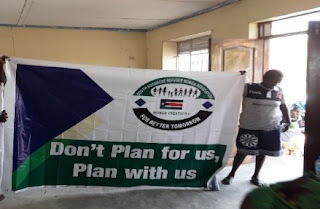
For months, refugee women in Uganda had been asking humanitarian actors to move food distribution points closer to where women lived. The women were tired of walking 10 kilometers to get to food and 10 km home, often getting attacked along the way. But the months rolled by, and nothing happened. So women took charge. The Yoleta Women’s Group organized a sit-down strike at the food distribution point, boycotting food distribution. They got men who support women’s rights to write a memo to UNHCR explaining why they were on strike. Now, UNHCR, WFP, and others deliver food directly to communities, and women don’t have to walk. Better yet, everyone in the community sees women as leaders who get things done and gets them involved in humanitarian decisions. Women Lead in Emergencies  is a small pilot inside a Global Affairs Canada project supporting South Sudanese Refugees in Uganda from 2018-2020.  It worked with 5 local women’s groups to help them build the networks and confid...

The Menstrual Cup

Image
My name is Diana. I am 26 years old, and I am a Congolese refugee living in Kyaka II Refugee Settlement. I participated in WoMena Uganda’s Menstrual Health Management (MHM) training in June 2019. I am now a Trainer of Trainers (ToT) on MHM in the settlement. I support adolescent girls and women in the settlement by providing them with information on MHM. I fled conflict in the DRC in 2008, at the age of 14 together with 3 members of my family. We arrived at the settlement and we were given disposable pads when being settled in Kyaka II. Since then, the distribution of necessary items hasn’t been reliable including sanitary pads. Sanitary needs to be provided on a routine basis. The disposable pads used to be distributed every 6 months, but then, it became even less, and it was difficult for girls and women in my community including myself to manage our menstrual periods. I had to use disposable pads and pieces of cloth which were very uncomfortable. When I moved long distanc...

5 Min Inspiration:- Women build solutions

Image
“Mata Masu Dubara [VSLA] members take their social responsibility very seriously towards their community. Let this crisis be a moment that can bind us in solidarity with each other.” –  Mariama Gambo, Niger “We have faced so many challenges that we have overcome. We’re convinced that our collective determination will beat COVID too.”   -Hawa Guindo, Mali Any time I start to feel overwhelmed by COVID 19 and all of its challenges, I take a minute to find out what women in VSLAs are doing to fight back. In true VSLA tradition, they are finding ways to take the smallest investments and use them to change the world. As they have done for  dozens of crises before COVID , women VSLA members are providing solutions that keep themselves, their families, and their communities safe. Supporting these women is an enormous privilege for CARE, and an activity that helps us reach more than 10.3 million VSLA members. VSLAs in  9 countries have already adapted  what they’re do...

5 min inspiration: Goats , sleep and stress-relief

Image
‘What makes me feel well in my heart? My goat. . . Every morning when I wake up the first thing that I see is my goat, tied up to the tree. Then I smile. … Someone could come and kill that goat. … But it would not matter. I could get another goat, because I bought the goat myself, with my savings. And now I have the power to solve my problems and take care of my daughter. I never have to be afraid again!’ Minani, Burundi COVID 19 is providing a brutal reminder that stress, anxiety, and psychosocial support are huge parts of the response to pandemics.  Coping with the physical disease isn’t enough . We need to support the whole human and help people manage feelings of isolation, loneliness, and anxiety. As Minani tells us, supporting the whole person may come in unexpected ways. Minani is a powerful reminder that if you can help people find stability and emotional support, they can change the world themselves. They can unlock solutions to solve not only their own problems b...

5 min inspiration: Refugee men transform themselves the world

Image
“I am a transformed man; I want to be exemplary in my community.... I teach my son every day to support the women and girls in our lives because our family’s success depends on it.” In July 2018, CARE International in Uganda conducted a case study, funded by ECHO, on how an Engaging Men and Boys approach can be used in a refugee context. The Role Model Men approach is usually implemented as development, spanning several years. However, CARE wanted to learn more deeply how this can work in a refugee setting, building upon previous experience from ECHO and UNFPA funded projects. CARE International in Uganda has been engaging in the Role Model Men approach since 2010, first focusing on the post-conflict environment.  In total, CARE has trained 1,105 RMM&Bs across the West Nile region who have mentored over 11,050 men and boys in over 8 projects. The case study indicated positive changes in the lives of Role Model Men, their families, and community members. This includes a chang...

Richard: Personal Story of a Role Model Man

Image
October 1, 2018 My name is Towongo Richard, I am 23 years old from Yei, South Sudan. I married my wife in 2016 and we are blessed with a baby girl, who is now 1-year old. We started our journey to refuge in October 2017 around 6:00pm on a Sunday due to the ongoing civil war and target killings in South Sudan. Soldiers were killing people in our village without discrimination. We went about 1-mile into the bush to avoid the soldiers from the main road. I was moving with my bicycle, however it got spoiled and I had to abandon it. My wife, being very pregnant, was only able to carry some flour for cooking. We reached a water point and decided to make some food. The water tasted bitter but we were thirsty and hungry and had no choice but to use it. At around 2:00am we reached the foot of Nyangliba mountain and decided to rest there for the night. Role Model Men and Boys in training. After a couple days, we reached the Democratic Republic of Congo (DRC) border. We entere...