Posts

Diana: "Ruby Cup Made Me Pround To Be A Woman"

Image
Diana in Kyaka II before heading to do her day-to-day activities. CARE Uganda My name is Diana. I am 26 years old, and I am a Congolese refugee living in Kyaka II Refugee Settlement. I participated in WoMena Uganda’s Menstrual Health Management (MHM) training in June 2019. I am now a Trainer of Trainers (ToT) on MHM in the settlement. I support adolescent girls and women in the settlement by providing them with information on MHM. I fled conflict in the DRC in 2008, at the age of 14 together with 3 members of my family. We arrived at the settlement and we were given disposable pads when being settled in Kyaka II. Since then, the distribution of necessary items hasn’t been reliable including sanitary pads. Sanitary need to be provided on routine basis. The disposable pads used to be distributed every 6 months, but then, it became even less, and it was difficult for girls and women in my community including myself to manage our menstrual periods. I had ...

Abattoir Set to Improve Beef Quality in Moroto, Uganda

Image
  Official opening of the 3rd Arbattoir in Moroto, Uganda Moroto District in Karamoja, Uganda, is a semi-arid region where the community practice pastoralism. The community relies on cattle herding for their sustenance. However, the quality of the meat consumed on the market has been questionable since the district has had only one slaughterhouse. According to Dr. Denis Baraza Wabwire, the Moroto District Veterinary Officer, slaughters have always been carried out in the bushes by herders. They did this to evade tax paid when accessing the abattoir. Unfortunately, by doing this they were exposing consumers to health risks and causing a loss of revenue to the district.   “Most of the meat being consumed in Karamoja is from animals largely slaughtered in a kraal or the bushes which gives meat inspectors a hard time to access for inspection. Under the Animals and Public Health Act, any meat intended for human consumption, must be inspected”, said Dr. Wawire...

[PRESS RELEASE]: Women and Girls Left Vulnerable in Worsening Somalia Drought Crisis

Image
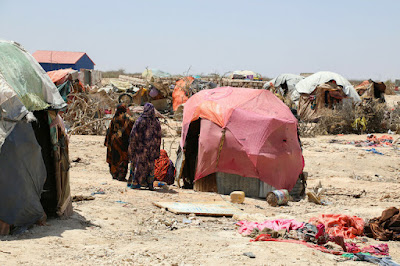
Women in IDP camps in Somalia. CARE With the drought intensifying in Somalia, the protection of women and girls is at a higher risk now than ever. Protection is one of the least funded clusters at only 11.4%. With $127.7Million required, only $14.5 Million has been allocated. A recent CARE report showed that as gender inequality goes up, food security goes down. Women are eating the last and least portions. In some parts where men would report eating fewer meals, women were not eating any meals at all. The worsening drought in Somalia has resulted in women having to walk farther to access water and basic services leaving them vulnerable to sexual violence. More girls are dropping out of school putting them at risk of early marriages. Parents who can no longer afford to pay for schools are resorting to prioritizing the boy child over the girl. The Key protection concern is Female Genital Mutilation (FGM). During the COVID-19 pandemic, it was noted that there was an increase in FG...

Eco-Clubs: Raising Environment Ambassadors in Uganda

Image
 Climate Change is wreaking havoc across the globe. From floods to uncontrollable wildfires, droughts, and cyclones, no corner of the earth has not felt the impact of climate change. Uganda has not been left unscathed. According to a recent report, 41% of Uganda’s total area is facing degradation with government reports indicating that 122,000 hectares are lost annually. One of the driving factors is that 90% of Uganda’s energy needs are met by fuelwood (both charcoal and firewood). With 80% of Uganda relying on farming and fishing for their sustenance, further degradation needs to be stopped. One of the ways that CARE International, and the European Union are doing this is by empowering the Youth   Portrait of Barak in school. Thanks to the trainings, he has not only gained knowledge in environmental conservation but also oratory skills. As a way of imparting practical skills and awareness to students so that they may serve as Environmental Ambassadors, Eco-Clubs were formed ...

A New Dawn for Girls in Ofiriha

Image
  Anite SPO -CARE posting a photo with CVO's ED Jane Amal While access to quality education for all is a basic human right, in South Sudan many children of school-going age are out of school. South Sudan has one of the lowest literacy rates [1] in the World, with the highest drop-out rates. An estimated 2.8 million [2] children are out of school and the highest proportion of out-of-school children are girls. Poverty, Child marriage, and cultural norms are some of the factors that hinder access to education. It’s estimated that half of South Sudanese girls get married before the age of 18. 17-year-old Sandra*, a mother of one is a testament to the impact of early marriage due to the lack of education opportunities in her community. “Having a school keeps girls busy and protects girls. The lack of school makes girls to get married early like me.” Says Sandra Sandra is a resident of Ofiriha, located between Magwi County and Torit west County of Eastern Equator...

Building Community Resilience and Sustainability in Zimbabwe

Image
Florence Talakufa at her home with one of her boer goats that enabled her to grow her herd. In a lot of communities in Africa, it is near impossible for women to have a say in family affairs or own any property. In Zimbabwe, women are tasked with the responsibility of taking care of the children and home. As a result of extreme climate change that led to the decimation of pasture lands for cattle and farms, women in the communities started rising and taking charge. This is worse in Region 5 which experiences an annual rainfall of 450mm or less, severe mid-season dry spells, and frequent seasonal droughts .   Florence Talakufa was one of the first female farmers to join the Zimbabwe Resilience Building Fund- Enhancing Community Resilience and Sustainability (ECRAS) project (ZRBF-ECRAS) in her village in 2017. During this time, many people in the community were bearing the brunt of intermittent dry weather conditions, that affected all matters related to farming.     ...

Saving Time While Saving the Environment

Image
Sister and her daughter Siyapula operating her biodigester powered cooker. Deforestation in Zimbabwe continues to spread at a high rate due to the over reliance on firewood in the rural areas. Indicators attribute this to be a key factor in some of the extreme weather change patterns that have affected several parts of the country. Climate change-induced drought has been traced in the southern parts of Zimbabwe like Mwenezi where people are inevitably forced to rely on wood for both cooking and selling to earn an income. This has several negative impacts not only on the environment but also on the health and safety of women and girls.     The time-consuming responsibility of fetching firewood is assigned to girls leaving them vulnerable to abuse and at a disadvantage when it comes to studying as they have less time.   Indoor pollution from open fires exposes women and children to smoke and soot leading to respiratory diseases.   Use o f wood as a source of ene...